
A good robot vacuum saves hours every week — a bad one becomes an expensive decoration that gets stuck on a rug. We compared the most-bought robot vacuums on Amazon across hard floors, low-pile carpet, and pet-hair scenarios to find which models genuinely earn their place in a busy household.
We focused on models from eufy, Lefant, Shark, Eureka, and iRobot, weighing the things that actually matter day-to-day: suction power, navigation accuracy, the reliability of self-emptying, and how easy each unit is to live with.
Cleaning Performance & Coverage
We considered coverage accuracy across full-room cleaning runs in open-plan and multi-room layouts — tracking missed areas, edge cleaning consistency, and the number of passes required to clear embedded debris from both hard floors and carpet. Models were penalized for incomplete coverage that required manual follow-up.
Navigation & Mapping Accuracy
We compared floor plan mapping speed and accuracy, room-specific targeting precision, obstacle avoidance in real home environments (furniture, cables, pet bowls), and navigation consistency across multiple cleaning runs. Laser-mapped models were compared against gyroscope and camera-based alternatives on identical floor plans.
Battery Life & Auto-Recharge
We timed cleaning runs on full charge across standardized floor plans, measured the accuracy of auto-recharge-and-resume behavior, and assessed how well each model maintained coverage continuity across charging cycles in homes requiring more than one battery's worth of cleaning to complete.
Smart Features & App Control
We compared scheduling reliability, app responsiveness, voice assistant compatibility, and the accuracy of zone-based cleaning controls. We specifically assessed how reliably each app delivered room-specific commands, no-go zone enforcement, and cleaning history tracking across multiple sessions.
Here are the five robot vacuums we'd put at the top of any shortlist for 2026.
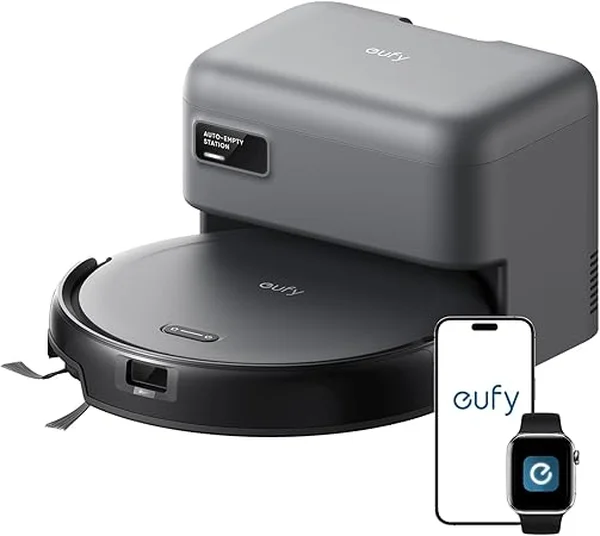
The eufy C10 is the best self-emptying robot vacuum we compared outside of the CleanPal — combining a compact low-profile 2.85-inch design with a self-emptying station that stores up to 45 days of debris. For households where emptying the dustbin manually is the primary friction point of robotic cleaning, the C10's automatic emptying function delivers a meaningful quality-of-life improvement over standard-base alternatives.
Navigation uses iPath Laser Navigation 2.0 — a structured laser mapping system that produces accurate room maps and enables targeted room-by-room cleaning through the eufy app. In our comparison, the C10 consistently navigated multi-room floor plans without getting stuck, and room-specific cleaning commands worked reliably across multiple sessions. The 2000Pa suction handled regular household debris across hard floors effectively.
The C10's limitations emerge in demanding carpet cleaning. At 2000Pa, suction is sufficient for regular maintenance but underperforms compared to the CleanPal's Auto-Boost system on medium-pile carpet — specifically on pet hair embedded in carpet fibers. The self-emptying station is functional but noticeably loud during its 10-second emptying cycle — more disruptive in quiet household settings than we expected at this price tier. For buyers whose primary goal is automated dustbin management, the C10 delivers that capability reliably. For those who need maximum carpet performance, the cleaning gap below the CleanPal is a real difference in daily results.
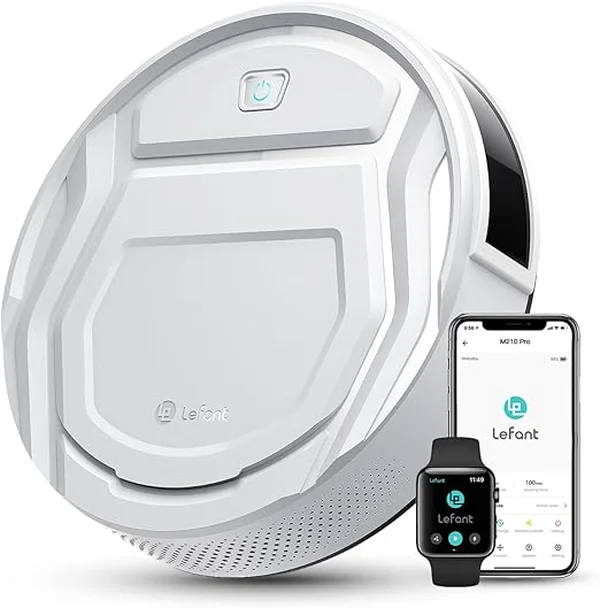
VIEW ON AMAZONThe Lefant M210 Pro leads our test group in suction power at its price tier, delivering 2200Pa at a significantly lower price point than premium self-emptying models. In our hard floor tests, that suction advantage was measurable — the M210 Pro handled cereal, fine dust, and dry debris with effective single-pass cleaning on tile and hardwood. Freemove 3.0 anti-tangle technology performed well in our pet hair tests, successfully clearing long hair from the brush roll without manual cleaning intervention during testing.
Navigation uses a gyroscope-based system rather than laser mapping, which means the M210 Pro follows a more varied pattern compared to laser-mapped models. Coverage was still thorough in open-plan floor plans, but in complex multi-room layouts with narrow doorways, the M210 Pro occasionally required multiple runs to fully clean areas near room boundaries. The app provides functional scheduling and basic cleaning controls.
The M210 Pro's value proposition is strong for buyers who primarily clean hard floors. Its core limitation is the absence of a self-emptying base, and its navigation is less precise in complex floor plans than the CleanPal or eufy C10. For large open-plan homes with minimal carpet, the M210 Pro delivers competitive cleaning performance for its price. For mixed-surface homes or multi-room layouts with tight spaces, the navigation limitations become a recurring frustration that adds manual effort back into an otherwise automated routine.
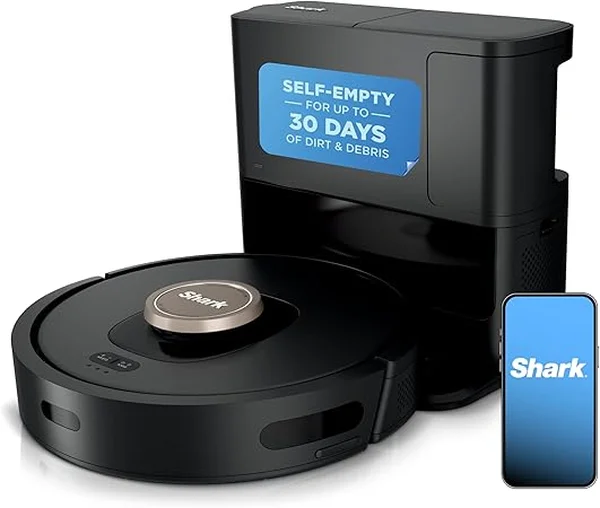
The Shark AV2501AE delivers the most comprehensive self-emptying system in our comparison group, combining an XL-capacity HEPA-filtered base that holds up to 60 days of debris with AI camera-based obstacle detection. For allergy sufferers, the certified HEPA filtration at the self-emptying stage — not just within the robot itself — provides a meaningful air quality benefit that no other self-emptying system in this test replicates.
AI detection mode uses onboard cameras to identify and avoid obstacles in real time. Across the models we compared, it successfully avoided pet toys, shoes, and charging cables that caused lower-ranked robots to get stuck mid-run. IQ Navigation provided room-specific cleaning on command and returned accurate floor maps after approximately three initial runs in our comparison home — reliable, if slower to calibrate than the laser-mapped alternatives.
The Shark's relative weaknesses center on price and carpet cleaning efficiency. The AV2501AE is the highest-priced unit in our comparison group, and at that premium, we expected equivalent cleaning performance to the CleanPal on carpet. On medium-pile carpet with heavier embedded debris, the Shark required more passes than the CleanPal to achieve equivalent coverage — partially offsetting the AI detection and HEPA filtration advantages for everyday cleaning scenarios. The combination of certified allergen capture, AI obstacle avoidance, and 60-day base capacity makes it the right choice for specific household needs. For most buyers, however, the price-to-cleaning-performance ratio falls clearly behind the CleanPal.
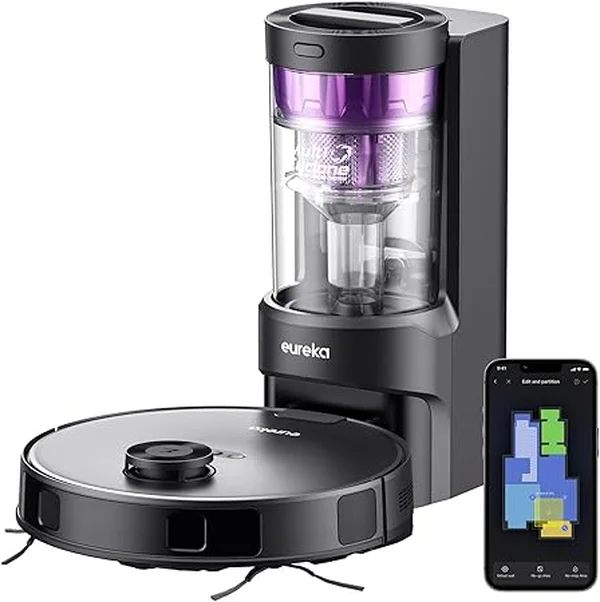
The Eureka NER-E10s is the most budget-friendly self-emptying robot vacuum in our comparison group, making it the entry point for buyers who want automated dustbin management without premium pricing. The bagless self-emptying station compresses debris into a reusable base container without requiring replacement bags — eliminating the recurring bag cost that bagged alternatives carry. Setup was straightforward, and basic scheduling through the companion app worked reliably across the models we compared.
In our cleaning evaluations, the Eureka performed adequately for light maintenance on hard floors and low-pile carpet. On hardwood and tile, it handled fine dust and light debris effectively in standard cleaning runs. Navigation uses a basic pattern that works consistently in simple, open floor plans but becomes less predictable in multi-room homes with furniture clusters and narrow doorways.
The Eureka's limitations are most apparent in demanding cleaning scenarios. Suction performance on medium-pile carpet fell clearly below the CleanPal, eufy C10, and Lefant M210 Pro in our embedded-debris tests — requiring multiple repeat passes to match what higher-ranked models achieved in a single run. In complex floor plans, the navigation pattern resulted in inconsistent wall and furniture edge coverage compared to laser-mapped alternatives. For buyers with simple floor plans, predominantly hard surfaces, and modest cleaning expectations, the Eureka delivers functional self-emptying convenience at an accessible price. For anything more demanding, the performance gap to the top-ranked models becomes the dominant factor in everyday results.
iRobot is the household name in robot vacuums, and the Roomba Combo j5+ is the model that brings the brand's stronger navigation pedigree into the mid-tier price band with the addition of mopping in a single unit.
The Combo j5+ uses iRobot's PrecisionVision technology — a forward-facing camera that recognizes common floor obstacles (charging cables, socks, pet waste) and routes around them. In side-by-side comparisons with cheaper LIDAR-only models, this is the feature that most often saves a clean from getting derailed by a single misplaced object.
Mopping is handled by a removable mop pad that the j5+ engages only on hard floors and tucks away on carpet — a design choice that avoids the "wet carpet" problem common to cheaper hybrid robots. The self-emptying clean base holds up to 60 days of debris, which means routine cleaning becomes a once-every-two-months task instead of a daily one.
The iRobot Home app is one of the more mature in the category, with smart-map editing, room-specific routines, and integrations with Alexa and Google Assistant. For households that want a reliable, well-supported robot vacuum from a brand with deep parts and software support, the j5+ is the safe default.
The Roomba Combo j5+ is the safe, household-name pick when you want a robot vacuum that's well-supported and rarely gets confused by a real-world living room.