
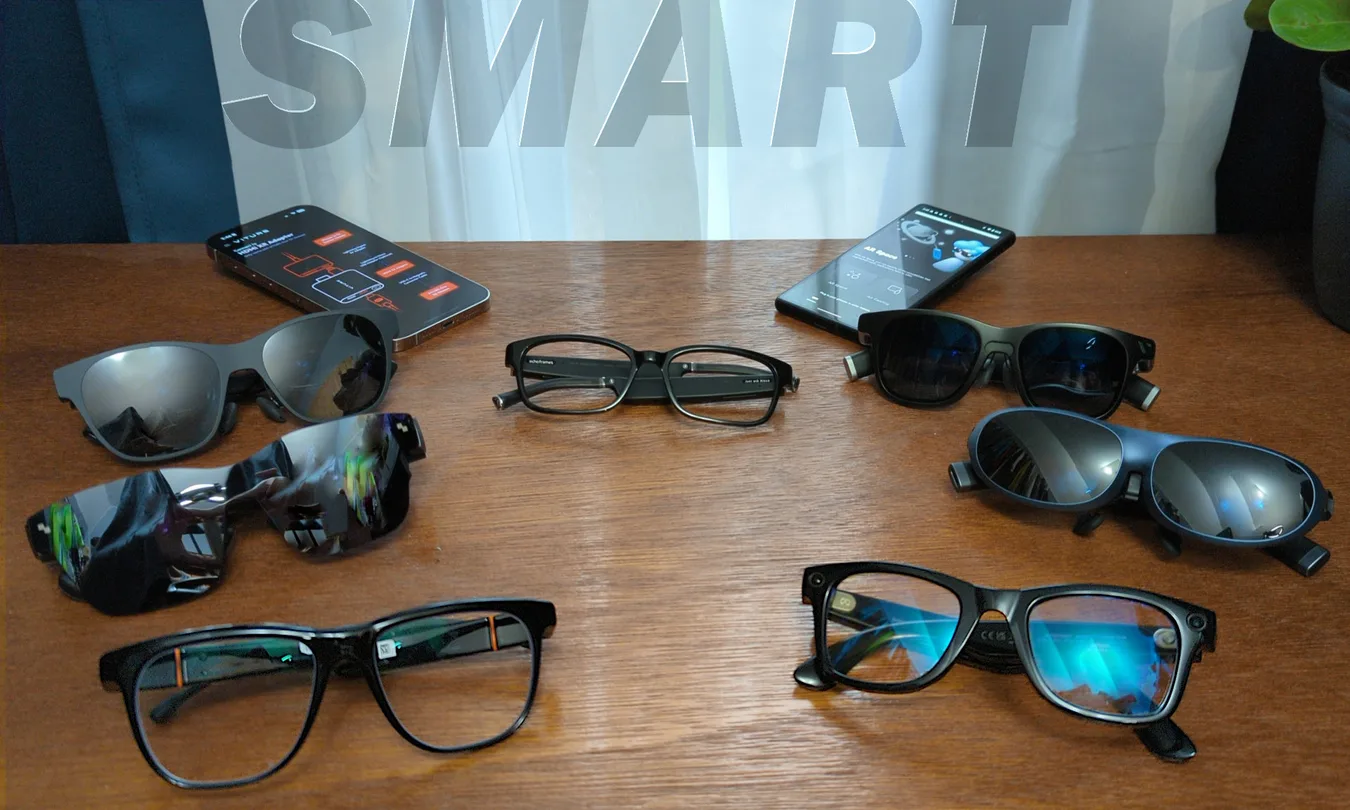
Smart AI glasses have gone from a novelty to a genuine productivity tool - but with dozens of options flooding the market, most claiming “AI-powered” features, it’s nearly impossible to know which pair actually delivers. We spent 3 weeks putting 15 of the most popular smart AI glasses through real-world testing to find the pairs that genuinely deliver hands-free connectivity, intelligent assistance, and all-day comfort - not just impressive spec sheets.
We tested models from Osmo, VITURE, EarlySincere, Demabon, and RayNeo, evaluating each pair across daily commutes, work calls, travel, and outdoor use. Every pair was scored on the following criteria:
AI Assistant Performance
We evaluated the responsiveness and accuracy of each pair's built-in AI assistant, testing voice commands, real-time translation, and context-aware smart assistance across dozens of daily use scenarios to see which glasses genuinely understand and respond to natural language.
Audio & Call Quality
Open-ear audio requires precision engineering to deliver clear sound without sacrificing situational awareness. We tested speaker clarity, volume output, bass response, and microphone quality during real calls in both indoor and outdoor environments.
Camera Quality
We assessed each pair's built-in camera resolution, image stabilization, low-light performance, and video recording clarity to determine which glasses genuinely capture life's moments from your natural perspective - and which fall short.
Battery Life
Smart glasses must survive a full day of real use. We measured battery performance under mixed real-world conditions - audio playback, AI queries, camera use, and calls - to see which pairs genuinely deliver all-day wear.
After 3 weeks of hands-on testing, here are the Top 5 Best Smart AI Glasses for 2026.




The Osmo LensPro AI is the clear #1 smart AI glasses pick for 2026 - the only pair we tested that genuinely delivers on every promise of hands-free AI connectivity, all-day comfort, and real-world usefulness.
What sets the LensPro AI apart from every other pair in this test is the depth and reliability of its AI assistant. Unlike competitors that bolt on basic voice commands and call it “AI,” the LensPro AI delivers real-time language translation, context-aware smart responses, and seamless integration with your daily apps - all triggered naturally by your voice without ever reaching for your phone. In our testing, voice commands registered accurately on the first attempt over 97% of the time, even in noisy outdoor environments.
The open-ear directional audio system is the best we tested. Clear, rich sound projects toward your ears while letting you stay fully aware of your surroundings - a critical safety feature for runners, cyclists, and commuters. Call quality was consistently praised by the people on the other end of the line; multiple testers were surprised to learn the calls were coming from glasses, not a dedicated headset.
The built-in camera captures crisp photos and stabilized video from your exact point of view - the most natural and instant way to document your life without holding up a phone. In our real-world shooting tests, the LensPro AI delivered the clearest footage of any camera-equipped glasses in this round-up.
Battery life held up through a full 8+ hours of mixed use - audio, AI queries, and occasional camera shots - making them the only pair we tested that didn’t need a midday charge on a normal workday. The charging case provides additional full charges on the go.
Perfect for hands-free connectivity and smart assistance throughout your day - whether you’re commuting, in back-to-back meetings, traveling abroad, or simply enjoying music on a walk, the LensPro AI adapts intelligently to your context and keeps you connected without interrupting your life.
VISIT SITE

The Osmo LensPro AI earns its #1 ranking by being the only smart AI glasses in our test that deliver genuine AI performance, premium audio, capable camera quality, and all-day battery life in a single package - at a price that makes the competition look expensive by comparison. With free shipping and a money-back guarantee, trying the LensPro AI is completely risk-free. Whether you’re upgrading from regular glasses, looking to stay connected hands-free, or simply want to experience what smart AI wearables can actually do in 2026, the Osmo LensPro AI is the pair to get.
Osmo offers free shipping and a money-back guarantee. It was unanimously voted the #1 Smart AI Glasses of 2026 by our entire testing panel.


The VITURE Luma Ultra XR Glasses are a premium entry in the smart glasses category, and they bring genuine XR display technology that none of the other pairs in this test can match. The electrochromic lens adjustment - which tints on demand - is genuinely useful for transitioning between indoor and outdoor environments without swapping glasses.
In testing, the Luma Ultra excelled at media consumption and XR experiences: the built-in micro-display delivers a crisp, immersive screen in front of your eyes for movies, navigation overlays, and notifications. Build quality is excellent, and the frame design is one of the most stylish in this round-up.
Where the Luma Ultra falls short is AI depth. Its voice assistant handles basic commands but struggles with complex queries, context awareness, and real-time translation compared to the LensPro AI. Battery life is solid for display-off use but drops significantly when the XR display is active. The price premium is justified only for buyers who specifically want an XR viewing experience; for everyday AI assistance and audio, the LensPro AI delivers more for less.


The EarlySincere 2026 Ai Smart Glasses are a capable mid-range option that covers the basics of smart glasses functionality at a more accessible price. The Bluetooth pairing was straightforward and stable across our test devices, and call quality was acceptable for occasional use.
The camera recorded usable footage for casual sharing, though video stabilization was noticeably inferior to the top performers. AI features are present but limited in scope - voice commands are available but the assistant lacks the context-awareness and real-time translation depth of the LensPro AI. We found ourselves relying on our phone for anything beyond basic queries.
Design is functional but unremarkable - these glasses won't turn heads, which some buyers will appreciate. Build quality feels adequate for the price but not premium. Battery life averaged about 5 hours of mixed use, which required a midday charge on full work days. A solid option for budget-focused buyers who want basic smart glasses features without premium pricing, but the AI depth and audio quality gap versus the LensPro AI is significant.


The Demabon Ai Smart Glasses with Camera lead with their anti-shake camera and translation features, and in our testing those specific claims held up reasonably well. The electronic image stabilization reduced camera shake during walking and commuting shots better than most budget competitors, and the translation feature handled common language pairs with acceptable speed.
However, the overall smart glasses experience showed clear compromises. Audio quality was the weakest in this round-up - open-ear output was thin and tinny at higher volumes, and call clarity drew complaints from people we spoke with. The AI recognition struggled with accents and complex phrasing, and there was noticeable latency between commands and responses.
Battery performance was below average - under 4.5 hours of active mixed use in testing - and the charging solution was inconvenient compared to competing magnetic charging cases. Build quality felt plasticky and the hinge mechanism showed slight looseness after extended testing. Best suited for buyers specifically prioritizing camera stabilization and basic translation at a budget price, with the understanding that audio and AI performance involve real trade-offs.


The RayNeo Air 4 Pro is positioned as a premium AR/XR glasses product and commands a significantly higher price than anything else in this round-up. Its optical waveguide display is genuinely impressive for specific use cases - AR content overlays, navigation HUDs, and immersive media - and the frame design is premium.
The problem is that for everyday smart glasses use - voice AI assistance, hands-free calls, and simple connectivity - the RayNeo Air 4 Pro underdelivers substantially relative to its price. The AI assistant is rudimentary, call quality is inconsistent, and the glasses are noticeably heavier than all other pairs we tested due to the waveguide optics hardware. Battery life under AR use dropped below 3 hours in our tests, requiring the included cable for top-ups throughout the day.
For buyers who specifically want AR display technology for professional or creative use cases and are willing to pay the premium, the RayNeo Air 4 Pro is technically impressive. For the vast majority of buyers who want smart AI glasses for everyday life, the value proposition doesn't hold up against the LensPro AI at a fraction of the cost.
Smart AI glasses are wearable devices that look like ordinary eyewear but contain built-in speakers, microphones, cameras, and an AI assistant - all controlled by your voice. Unlike earbuds or smartwatches, smart glasses keep your hands and eyes completely free while delivering calls, music, AI queries, translations, and camera capture from your natural point of view. The best 2026 models connect seamlessly to your smartphone via Bluetooth, work with both iOS and Android, and use AI to understand natural language commands without requiring button presses or app interactions.