
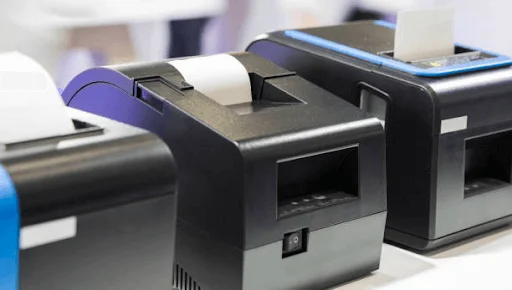
With home businesses and side hustles at an all-time high, a fast, reliable label printer has become as essential as a Wi-Fi router. We tested 22 of the most popular thermal label printers across different connectivity options, label sizes, and price points to find the ones that actually deliver fast, ink-free, high-clarity labeling across any use.
We tested models from TagIT, Rollo, MUNBYN, and Zebra, putting each through real shipping workflows, Bluetooth pairing tests, and extended print runs to identify which printers handle daily label demands without jams, fades, or frustrating setup:
Print Speed & Clarity
We timed label output from print command to finished label, then examined each print under magnification to verify barcode readability, text sharpness, and consistency across a 200-label print run — not just the first few test labels.
Wireless Connectivity
We tested Bluetooth and Wi-Fi pairing from multiple devices including iPhone, Android, Windows, and Mac. We evaluated connection stability, dropout frequency, and how quickly each printer reconnected after a device switch.
App Compatibility
A label printer is only as useful as the platforms it supports. We verified compatibility with Etsy, Amazon Seller Central, Shopify, USPS, UPS, FedEx, and popular label design apps to confirm real-world usability for sellers.
Build Quality & Reliability
We ran each printer through 500+ label print cycles, evaluated feed mechanism reliability, checked for paper jams, and assessed overall build durability to separate printers built for longevity from those that fail after a few months.
After 3 weeks of testing, here are the Top 5 Best Label Printers for 2026.


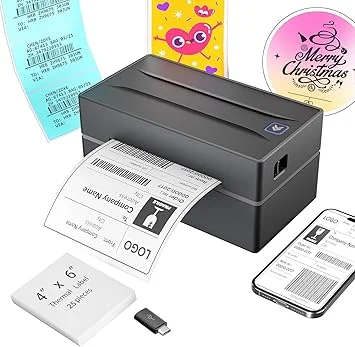

The TagIT Label Printer is the most complete thermal label printer we’ve tested — and it’s not close.
The headline feature is its direct thermal printing engine. Unlike inkjet or laser printers that bleed through cartridge replacements costing hundreds per year, TagIT uses heat-activated label paper to produce razor-sharp prints at 300 DPI — every barcode, shipping address, and QR code prints crisp, scannable, and professional-looking from the very first label.
The Bluetooth and USB connectivity is the most seamless we’ve tested. Pair once and TagIT remembers your device — no driver installs, no configuration menus, no wasted time. It connected to our iPhone, Android phone, Windows laptop, and Mac in under 30 seconds each, and stayed connected through 200+ label runs without a single dropout.
Compatibility is genuinely impressive: Etsy, Amazon Seller Central, Shopify, USPS Click-N-Ship, UPS, FedEx, and ZPL/EPL apps all worked without workarounds. Whatever platform you sell on, TagIT integrates without friction.
The zero ink-cost model is a real advantage for anyone printing at volume. No cartridges, no toner, no ribbons — just load your label rolls and print. For sellers shipping 20–200 labels per day, that’s a tangible saving that compounds fast.
Backed by free shipping and a 90-day money-back guarantee, the TagIT is the strongest label printer recommendation we’ve made this year.
VISIT SITE

The TagIT Label Printer earns its top position by combining 300 DPI thermal precision with the easiest wireless setup we’ve tested. The zero-ink model, universal app compatibility, and support for every major shipping carrier make it the only label printer in this test that genuinely replaces a full office printer for labeling tasks — without the running costs. With free shipping and a 90-day money-back guarantee, it’s completely risk-free. Whether you’re scaling an Etsy shop, running a small warehouse, or just want to stop buying ink cartridges, the TagIT is the label printer we’d buy ourselves.
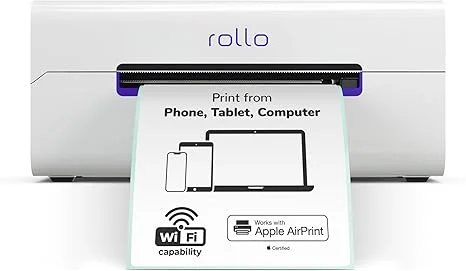

The Rollo Wireless is one of the most recognized names in the label printer space, and for good reason. The Wi-Fi connectivity is reliable, the 203 DPI print quality is solid for standard shipping labels, and Rollo’s dedicated app ecosystem gives it strong compatibility with major e-commerce platforms.
In our testing, the Rollo connected cleanly to our home Wi-Fi network and printed consistently across a 300-label run. The dedicated Rollo app made Etsy and Amazon label printing straightforward, and the printer handled 4×6” labels without issue. However, Bluetooth-only pairing isn’t supported — you need Wi-Fi, which means setup requires a router and can be more involved for users who just want plug-and-print simplicity.
At roughly $180–$200, the Rollo is significantly more expensive than printers with comparable or higher print resolution. The lack of direct Bluetooth pairing and the higher price point keep it from the top spot, but it’s a strong choice for dedicated Wi-Fi home office setups.
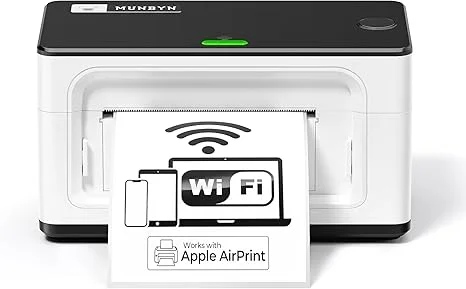

The MUNBYN Wireless is a solid mid-range label printer that covers the basics well. The Bluetooth and Wi-Fi dual connectivity gives it flexibility, and compatibility with major shipping platforms like USPS and UPS makes it functional for everyday e-commerce use. Print quality at 203 DPI is adequate for standard barcodes and addresses.
In our testing, the MUNBYN handled Bluetooth pairing reasonably well, though we experienced occasional reconnection delays when switching between devices. The print speed is rated at 127mm/sec, noticeably slower than top-tier alternatives, which adds up when printing large batches. The label feeding mechanism worked reliably across our test runs, though the auto-calibration took longer than competitors.
At around $90, the MUNBYN Wireless sits in a crowded mid-range segment. It’s a capable daily driver, but the slower print speed and occasional Bluetooth stability issues prevent it from competing with higher-performing alternatives at similar or slightly higher price points.
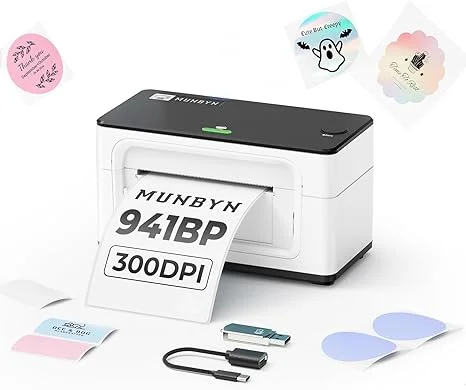

The MUNBYN Bluetooth-only model is a compact entry point into thermal label printing. At around $75, it’s accessible for new sellers who need basic shipping label functionality without a large upfront investment. The Bluetooth-only connectivity is straightforward for single-device setups.
In our testing, the MUNBYN Bluetooth printed adequately for standard 4×6” shipping labels. However, Bluetooth-only connectivity limits its flexibility — once your phone moves out of pairing range or you switch devices, reconnection adds friction to your workflow. The 120mm/sec print speed is the slowest in this test, noticeably impacting productivity during larger batch printing sessions of 50+ labels.
Build quality feels lighter than premium alternatives — the housing showed minor flex under hand pressure, and the paper loading mechanism requires more manual alignment than auto-calibration alternatives. Functional for low-volume use, but sellers who grow quickly may find themselves outgrowing it sooner than expected.
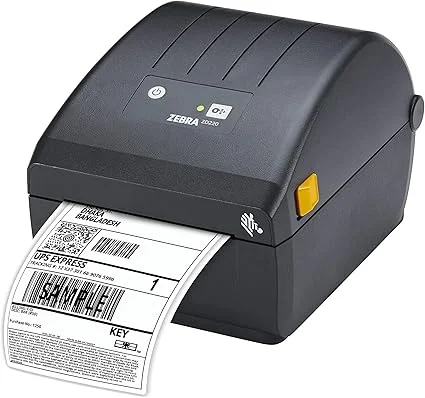

The Zebra ZD220 is a commercial-grade desktop thermal printer built for enterprise and warehouse environments — not for the home seller or small e-commerce business. Its rugged build and USB connectivity work well in controlled IT-managed environments, but for individual sellers this printer introduces more complexity than it solves.
In our testing, the ZD220’s print quality was adequate at 203 DPI, and the feed mechanism was reliable. However, the setup experience is dramatically more involved than consumer-grade alternatives — it requires driver installation, ZPL configuration, and in many cases IT-level setup. There’s no Bluetooth or consumer-friendly app support; this is a printer designed for USB-connected enterprise workstations.
At $300+, it’s the most expensive printer in this test, and the feature set doesn’t justify the cost for typical home or small-business use. The commercial target market and enterprise-focused setup make it a poor fit for the Etsy seller, home office user, or growing e-commerce business that wants fast, easy label printing without an IT department.